https://www.science.org/doi/10.1126/science.adv7953
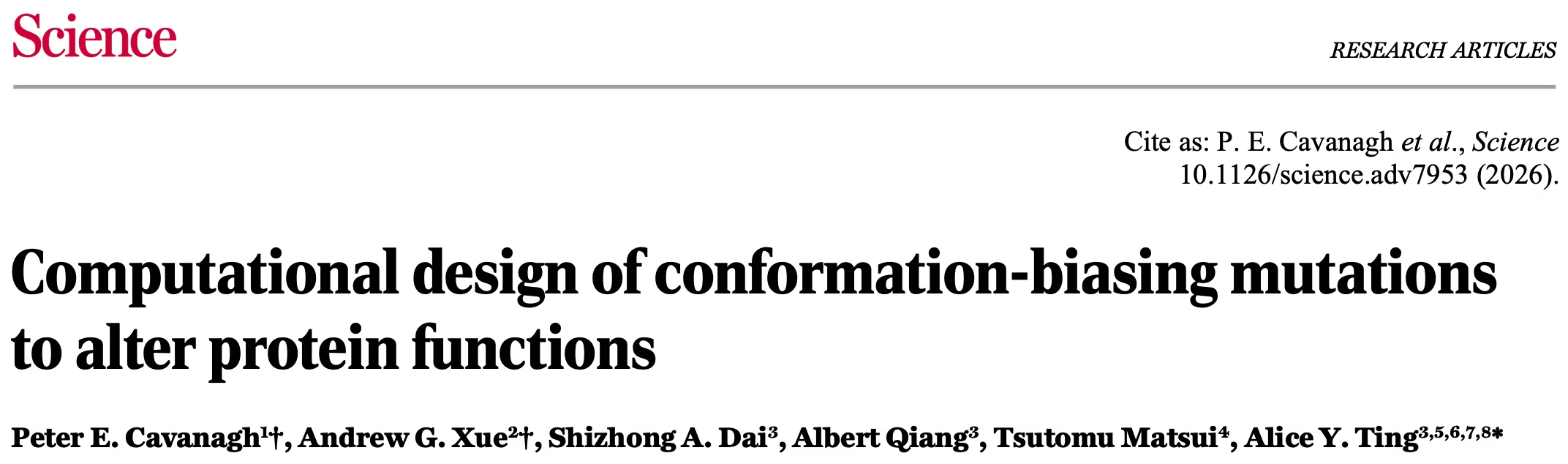
Computational design of conformation-biasing mutations to alter protein functions
Key figures
- [Figure 1]: Defines Conformational Biasing as contrastive inverse-folding scoring of every point mutant on two alternative backbone conformations.
- [Figure 2]: Shows that CB enriches functionally state-biased variants across K-Ras, SARS-CoV-2 spike RBD, β2AR, Src, B-Raf, FabZ, and MurA datasets.
- [Figure 3]: Validates CB-designed LplA conformational bias directly with SEC-SAXS and tryptophan fluorescence, including compensating double mutants.
- [Figure 4]: Links LplA conformational bias to protein-labeling selectivity, where open-biased variants increase promiscuous labeling and closed-biased T57I improves site-specific labeling signal-to-noise.
- [Figure 5]: Benchmarks CB against LplA SAXS, Trp fluorescence, and flow-cytometry data, and shows contrastive scoring outperforms single-structure inverse-folding scoring.
- [Supplementary Figure S6]: Identifies a concrete failure mode in which some CB-predicted open-biased LplA active-site variants likely sterically clash with BCN substrate.
- [Supplementary Figure S12]: Shows AFCluster performs poorly on LplA and cannot score 20% of point mutants because they are absent from the MSA.
- [Supplementary Figure S13]: Shows BioEmu partially recapitulates CB trends but correlates less well with LplA SAXS and Trp fluorescence than CB.
1) Thesis (one sentence)
To address the lack of fast, scalable methods for engineering proteins that switch between functional conformational states, in diverse conformation-switching proteins and E. coli lipoic acid ligase, Conformational Biasing causes state-specific shifts in binding, enzymatic activity, conformational occupancy, and labeling promiscuity by contrastively scoring mutations on alternative backbone conformations with inverse folding models, supported by deep mutational scanning benchmarks, SEC-SAXS, tryptophan fluorescence, flow cytometry, SDS-PAGE, imaging, and kinetic modeling.
2) Evidence card (three bullets only)
- Strongest result: (Fig. 3; Fig. 4; Fig. 5) In LplA, CB bias score correlated with SAXS-measured open-state occupancy (Spearman r = 0.81), Trp fluorescence change (r = -0.62), and promiscuous labeling activity (r = 0.67 after excluding substrate-clash variants), while 23/25 non-clashing open-biased variants increased promiscuity or Trp fluorescence change and 31/32 closed-biased variants decreased promiscuity.
- Method enabler: (Fig. 1; Fig. 2; Fig. 5; computational protein engineering + experimental validation using ProteinMPNN, ESM-IF1, Frame2Seq, ThermoMPNN, DMS datasets, SEC-SAXS, Trp fluorescence, flow cytometry, SDS-PAGE, and imaging) CB converts conformational design into a differential pseudo-log-likelihood problem, scoring each mutant on two state backbones and selecting variants with divergent state-conditioned inverse-folding scores.
- Critical limitation: (Fig. S6I; Fig. S12; Fig. S13; Supplementary Text 4) CB uses backbone/sequence information and does not model ligands, nucleic acids, catalytic turnover, or non-protein cofactors, so it can nominate mutations that disrupt required substrate binding, as seen for LplA variants predicted to be open-biased but likely sterically clashing with BCN.
Optional
Quote bank (2–4 short excerpts)
- Quote 1: “The speed and simplicity of CB make it a versatile tool for engineering protein dynamics with broad applications in basic research, biotechnology, and medicine.” (Abstract, page 1)
- Quote 2: “Overall, we show that CB enables mechanistically-informed improvement of conformation-specific functions across diverse protein types.” (Results, page 2)
- Quote 3: “Thus, while conceptually simple, the contrastive scoring objective used in CB is likely to be critical for predicting conformation-specific functions.” (Results, page 3)
- Quote 4: “These variants may tap into long-range allosteric networks that are not yet appreciated in the proteins under study.” (Discussion, page 6)
Key comparisons (1–3 lines)
- Compared to: Molecular dynamics, AlphaFold mutation scanning, AFCluster, BioEmu, and single-structure inverse-folding scoring.
- Win: CB is fast, mutation-sensitive, requires no fine-tuning, works from experimental or predicted state structures, and validated across multiple protein classes plus direct LplA conformational measurements.
- Tradeoff: CB requires meaningful alternative conformational structures and is best used for design enrichment, not for assigning the conformational effect of arbitrary individual mutations.
Methods I might copy (protocol hooks)
- Construct design / Models: Score all point mutants with ProteinMPNN using the ColabDesign JAX implementation; scale scores to mean 0 and standard deviation 1 per structure; calculate State A bias score as scaled State A score minus scaled State B score. For DMS analyses, select top 2.5% State A-biased and State B-biased mutants after filtering for scaled score above zero on at least one structure. For LplA, use open 3A7R and closed 1X2G, filter mutants whose score exceeds wild type on at least one structure, and apply W37V background for BCN-compatible labeling assays; tested 31 open-biased, 32 closed-biased, and 36 neutral LplA variants in mammalian cells.
- Conditions / Instruments: For Trp fluorescence, use purified His6-LplA at 10 µM in DPBS, 1 mM DTT, 5 mM MgCl2, 0.05% Tween-20, and 5% glycerol; record 290 nm excitation and 340 nm emission every ~30 s; add lipoyl-AMS to 50 or 100 µM final; measure three technical replicates. For SEC-SAXS, use tagless LplA at 1–10 mg/mL, add 500 µM lipoyl-AMS or lipoyl-AMP at 4°C for 20 min, run SSRL BL4-2 with Superdex 75 Increase 3.2/300, 40 mM Tris pH 7.5, 5 mM MgCl2, 150 mM NaCl, 5 mM DTT, 0.5 mM EDTA, 0.05 mL/min flow, Pilatus3 X 1M detector, 11.0 keV beam energy, and 0.009–0.73 Å−1 q range. For cell labeling, plate HEK293T cells at 10^5 cells per well in fibronectin-coated 24-well plates, transfect 500 ng mCherry-LplA plasmid with 4 µL PEI, express 24–48 h, label with 200 µM BCN for 5 min at 37°C, click with 200 nM methyltetrazine-BODIPY for 45 min at 37°C, and quantify by flow cytometry.
- Readout / Analysis: Fit SEC-SAXS curves with Oligomer using open and closed conformer models, use DENSS for ab initio envelopes, analyze Trp fluorescence as the ratio before and after lipoyl-AMS addition, quantify promiscuous activity as BODIPY/mCherry in a low-expression flow-cytometry gate, validate flow data against SDS-PAGE/in-gel fluorescence, and model LplA specificity with SciPy LSODA over 10 s using Kconf = 10^-3 to 10^1 and ETotal = 1 to 10^4 µM.
Open questions / Theoretical implications (2–5 bullets)
- Can contrastive inverse-folding scores identify allosteric control points in proteins whose conformational changes are coupled to ligand binding rather than intrinsic apo-state equilibria?
- Would ligand-aware inverse-folding models reduce false positives like LplA active-site variants that bias conformation but disrupt substrate chemistry?
- Can CB be extended from single-point design to combinatorial mutation sets without losing accuracy as mutational distance increases?
- Can CB distinguish conformational occupancy effects from altered catalytic cycling, nucleotide exchange, or altered binding-site chemistry?
- Can state-biasing mutations be used as mechanistic probes for hidden allosteric networks in small GTPases, kinases, GPCRs, and enzyme scaffolds?
![Read more about the article [Paper Review #6] Lipid-mediated intracellular delivery of recombinant bioPROTACs for the rapid degradation of undruggable proteins](https://pharmphd.com/wp-content/uploads/2026/02/image-3-300x175.avif)
![Read more about the article [Paper Review #28] Improving de novo protein binder design with deep learning](https://pharmphd.com/wp-content/uploads/2026/07/image-6-300x131.avif)
![Read more about the article [Paper Review #27] Single-Sequence Deep Learning Delivers Crystal-Quality Models of Covalent K-Ras G12 Hotspot Complexes](https://pharmphd.com/wp-content/uploads/2026/07/image-5-300x129.avif)