https://www.nature.com/articles/s41467-020-20671-6
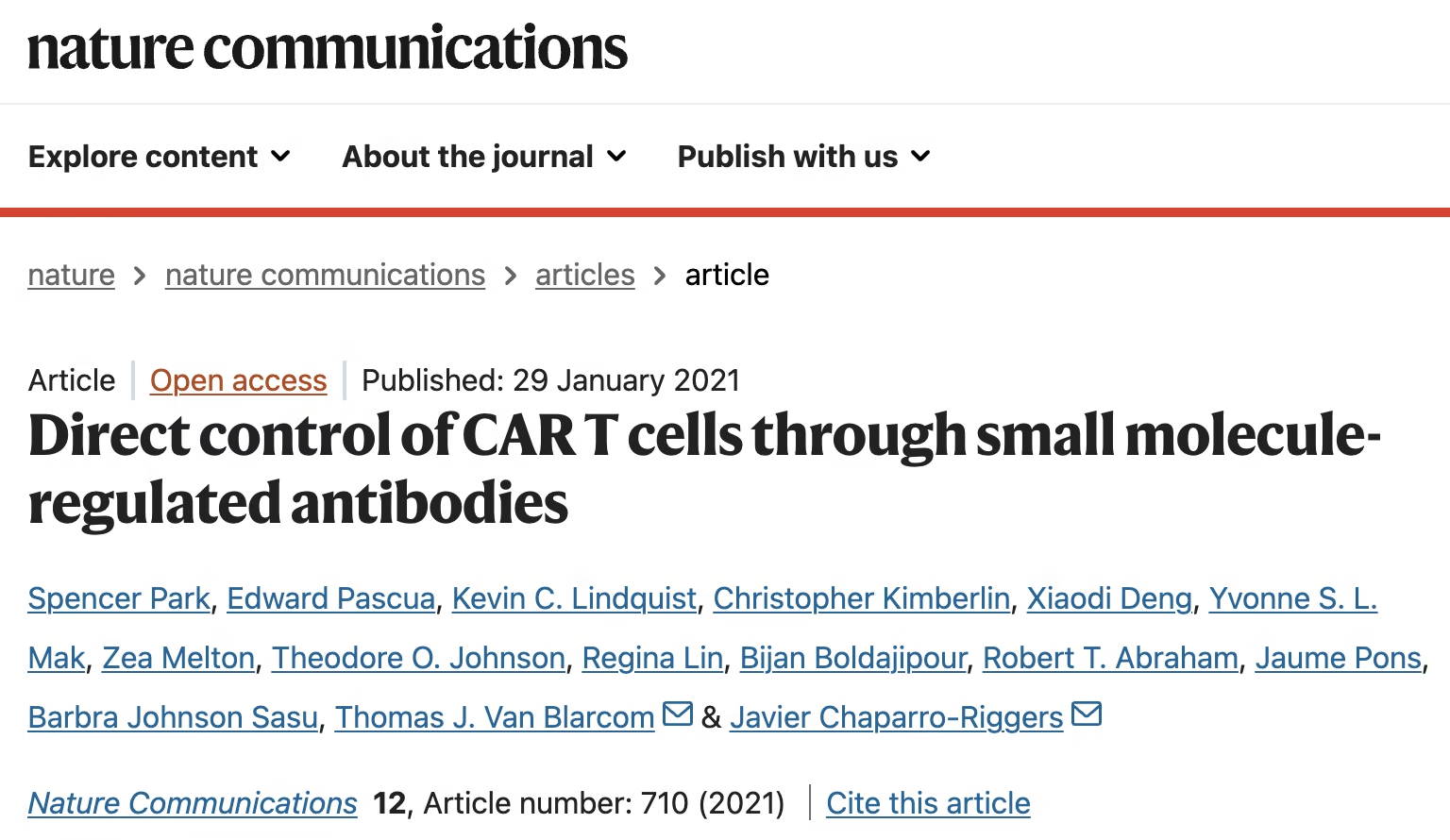
Direct control of CAR T cells through small molecule-regulated antibodies
Key figures
- [Figure 3]: Establishes that a single-module “conditional CAR” retains potent target killing yet is reversibly and dose-dependently suppressed by methotrexate, including in vivo modulation.
- [Figure 2]: Provides the structural mechanism for chemical control, showing MTX-induced paratope rearrangement (W32 flip and large CDRH3 shift) that can disrupt antigen binding.
- [Figure 1]: Defines the engineering blueprint (MTX-pocket grafting + diversified CDRs + phage display) that yields scFvs with dual specificity and MTX-dependent inhibition.
1) Thesis (one sentence)
To address the need for rapid, reversible control of potent CAR T cell activity without adding extra control modules, in single-module CAR T cells, grafting an MTX-binding pocket into scFvs and administering methotrexate causes reversible attenuation of antigen recognition and downstream cytotoxic/inflammatory outputs by MTX-induced paratope rearrangement that disrupts target binding, supported by SPR affinity/kinetics, X-ray crystal structures, in vitro functional assays, and mouse tumor studies.
2) Evidence card (three bullets only)
- Strongest result: MTX acts as a reversible, titratable OFF-switch for condCAR function in vitro and in vivo (e.g., cytotoxicity halts in MTX and returns when MTX is removed; transient MTX infusion delays tumor engagement then tumor regresses after withdrawal) (Fig. 3f–g).
- Method enabler: A human scFv scaffold with a grafted MTX pocket and diversified antigen-binding loops can be discovered by phage display and structurally rationalized by crystallography, with MTX binding triggering a specific conformational change (W32 inward flip and ~7.1 Å CDRH3 movement) (Fig. 1c; Fig. 2d; phage display + SPR + X-ray).
- Critical limitation: Effective switching required micromolar-to-high-micromolar MTX while MTX’s intrinsic cellular toxicity forced leucovorin rescue and DHFRmut engineering to interpret cell assays cleanly, constraining dosing/translation and complicating assay design (Fig. 3c–e; Supplementary Fig. 8).
Optional
Quote bank (2–4 short excerpts)
- Quote 1: “Antibody scaffolds capable of exhibiting inducible affinities could reduce the risk of adverse events by enabling a transient suspension of antibody activity.” (Abstract, p.1)
- Quote 2: “First, the addition of MTX to all the condCAR T cells decreased target lysis (Fig. 3b and Supplementary Fig. 9), confirming the conditional activity.” (Results, p.4)
- Quote 3: “In summary, we generated conditional antibodies whose binding affinity to a target antigen is modulated by a small molecule.” (Discussion, p.6)
Key comparisons (1–3 lines)
- Compared to: suicide switches and multi-module deactivation designs that add extra expressed components, and pathway-level pharmacologic suppression (e.g., kinase inhibitors) rather than receptor-level control.
- Win: single-module, extracellularly addressable control element embedded directly in the antigen-recognition domain enables rapid, reversible modulation without expanding lentiviral payload.
- Tradeoff: achieving strong inhibition can demand high inducer exposure and careful mitigation of inducer liabilities (here, MTX toxicity and off-target pharmacology).
Methods I might copy (protocol hooks)
- Construct design / Models: MTX-pocket grafting (CDRH1/CDRH2/FW3 from anti-MTX VHH) onto a human VH (M2J1) plus VL pairing; conditional scFv library with fixed MTX-binding regions and diversified CDRH3 + all three light-chain CDRs; CAR design places conditional scFv upstream of CD8α hinge/TM followed by 4-1BB and CD3ζ (Fig. 1a–c; Fig. 3a).
- Conditions / Instruments: SPR at 37 °C; scFv:MTX crystallization uses 1:10 molar mixing on ice for 1 h, Mosquito robot screening, diffraction at ALS beamline 5.0.2 (Pilatus) at 100 K and 1 Å wavelength; flow cytometry on an LSRII with FACSDiva and FlowJo; cytokines by MSD U-PLEX (Methods, p.7–9).
- Readout / Analysis: cytotoxicity via luciferase (One-Glo) after 48 h co-culture (example E:T = 1:1), activation via CD69 after 24 h (example E:T = 1:2), proliferation via CellTrace Violet (1 µM) over 7 days; MTX control commonly tested at 100 µM with leucovorin 1 mM and a maintained MTX:LV molar ratio of 1:10 when titrating (Fig. 3b–e; Methods, p.8).
Open questions / Theoretical implications (2–5 bullets)
- Can this “small-molecule pocket graft + paratope rearrangement” principle be generalized to more benign, bioorthogonal inducers without requiring toxic rescue regimens?
- What design rules best increase inducer sensitivity (lower EC50) while preserving high target affinity and low tonic signaling in receptor contexts?
- How often do conditional binders fail due to incomplete conformational coupling (ligand binds but does not sufficiently remodel the binding loops), and can structural screening predict that early?
- Could “analog design” (as suggested for MTX analogs) become a standard co-optimization knob alongside protein engineering for switch performance and safety?
![Read more about the article [Paper Review #9] Chemogenetic Control of Nanobodies](https://pharmphd.com/wp-content/uploads/2026/02/image-6-300x151.avif)
![Read more about the article [Paper Review #24] Discovery of Covalent Ligands with AlphaFold3](https://pharmphd.com/wp-content/uploads/2026/06/image-2-300x90.avif)
![Read more about the article [Paper Review #16] Deep learning–guided design of dynamic proteins](https://pharmphd.com/wp-content/uploads/2026/04/image-2-300x74.avif)