https://www.nature.com/articles/s41467-024-50235-x
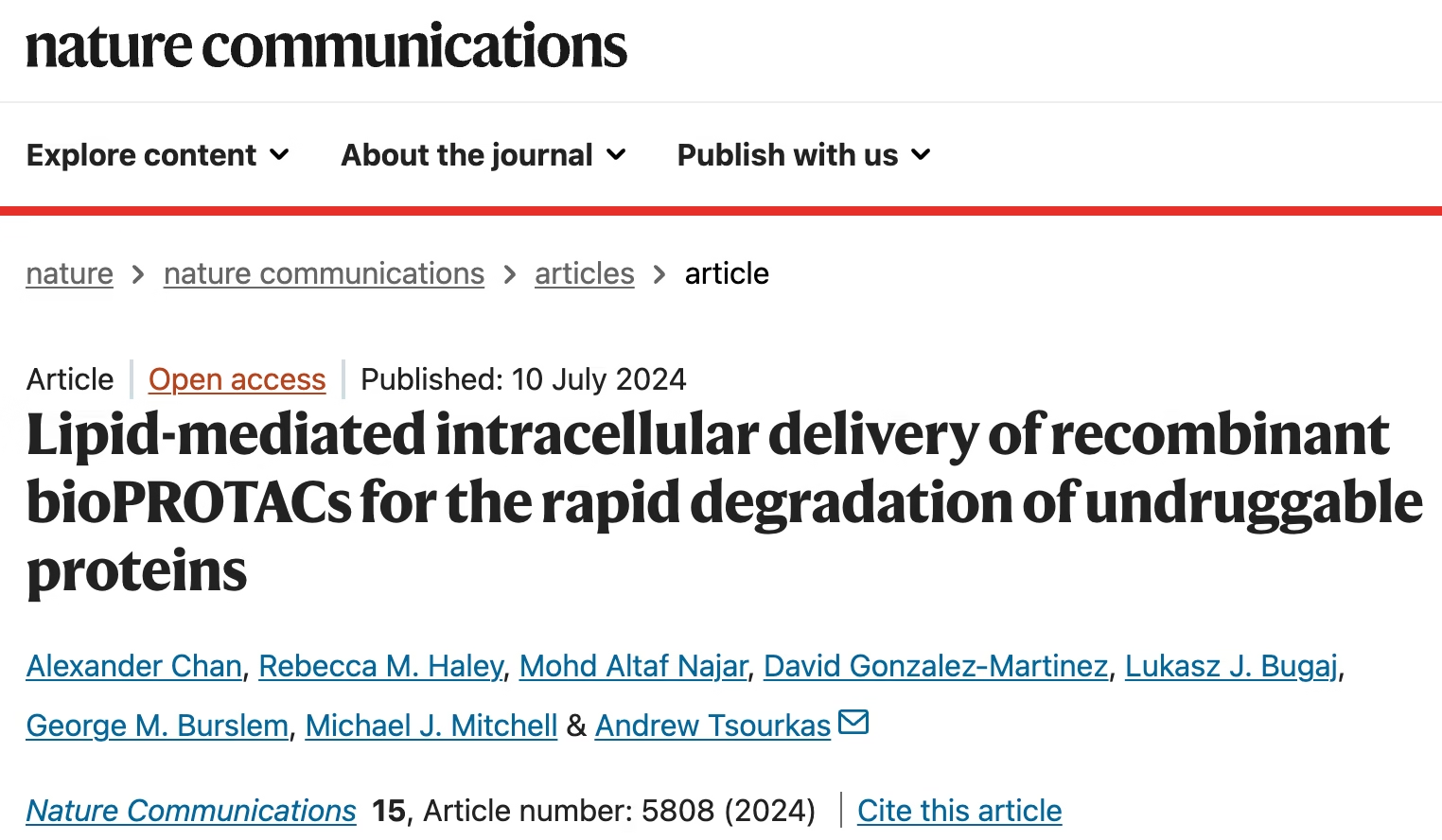
Lipid-mediated intracellular delivery of recombinant bioPROTACs for the rapid degradation of undruggable proteins
Key figures
- Fig. 5: Establishes the lead K1 LNP formulation achieving near-complete GFP-KRAS clearance plus dose response (DC50) and endogenous Ras knockdown.
- Fig. 6: Quantifies rapid degradation kinetics and compares recombinant protein delivery vs mRNA delivery, including recovery after washout.
- Fig. 7: Defines specificity and off-target liabilities via global proteomics, highlighting modality-dependent off-target profiles.
1) Thesis (one sentence)
To address bioPROTAC membrane impermeability that prevents general intracellular deployment, in unmodified mammalian cells, ApP-tagged IpaH9.8 bioPROTACs formulated in lipid nanoparticles cause rapid near-complete target depletion within hours by electrostatic lipid complexation enabling cytosolic delivery and ubiquitin-mediated degradation, supported by flow cytometry, western blotting, live-cell microscopy, and shotgun proteomics.
2) Evidence card (three bullets only)
- Strongest result: K1 LNP delivery of IpaH9.8-K27-D25-s11 drives ~95% GFP-KRAS elimination (200 nM, 8 h) with DC50 = 19.5 nM, and degrades endogenous Ras by western blot (Fig. 5B-D, H-I).
- Method enabler: A modular E3-binder-ApP(-s11) architecture that electrostatically complexes with cationic/ionizable lipids and is formulated by microfluidic LNP mixing, with cytosolic delivery quantified by split-GFP(1-10)/s11 complementation and flow cytometry (Fig. 1; Fig. 4B-C; Fig. 5A, F-G).
- Critical limitation: Proteomics reveals binder-driven and modality-driven off-target depletion, including GNAI1/2/3 (Ras-like P-loop/G-box proteins) reduced in both active modalities, and broader off-target knockdowns (for example tubulins) enriched in mRNA delivery relative to recombinant protein delivery (Fig. 7D, F).
Optional
Quote bank (2–4 short excerpts)
- Quote 1: “these modified bioPROTACs can rapidly degrade intracellular proteins, exhibiting near-complete elimination (up to 95% clearance) of targets within hours of treatment.” (Abstract, page 1)
- Quote 2: “The target half-life following protein delivery was calculated to be 97 min” (Target degradation kinetics with LNP-delivered bioPROTAC, page 8)
- Quote 3: “Thus, we suspect guanine nucleotide-binding protein G(i) subunit alpha is a bona-fide off-target for DARPinK27.” (Global proteome response to bioPROTAC treatment, page 10)
Key comparisons (1–3 lines)
- Compared to: Lipofectamine protein transfection and LNP-delivered bioPROTAC mRNA.
- Win: Faster, higher-amplitude knockdown with K1 LNP protein delivery and fewer global off-target perturbations than mRNA in proteomics.
- Tradeoff: Target specificity is constrained by binder cross-reactivity (for example GNAI family) and depends on LNP lipid composition to manage toxicity.
Methods I might copy (protocol hooks)
- Construct design / Models: N-terminal IpaH9.8 NEL (or SPOP) fused to DARPin (for example K27, 3G124), C-terminal D25 ApP plus GFP s11; tested in 293T GFP-KRAS and GFP(1-10) split-GFP reporter lines, plus multiple cancer lines (Methods, pages 15–17).
- Conditions / Instruments: Protein LNPs via microfluidic mixing ethanol:aqueous 1:3; protein aqueous phase in 1x PBS adjusted to pH 5 with 150 mM NaCl; LNP size by DLS (Zetasizer Nano); flow cytometry on CytoFLEX with FlowJo v10; microscopy on Nikon Ti2-E with Yokagawa CSU-W1/W2 spinning disk (Methods, pages 16–18).
- Readout / Analysis: GFP depletion by flow cytometry (geometric MFI) and western blot densitometry (ImageJ); proteomics on Orbitrap Exploris 240 with Proteome Discoverer and label-free quantification (Methods, pages 16–18).
Open questions / Theoretical implications (2–5 bullets)
- Can binder engineering (or alternative scaffolds) eliminate GNAI-family cross-reactivity while retaining Ras engagement?
- What fraction of degradation for membrane-associated targets is routed through UPS vs endosomal-lysosomal pathways, and can that be tuned?
- Can recombinant protein delivery be extended to in vivo tissue targeting without increasing LNP-driven toxicity or inflammatory responses?
- Does degrader self-ubiquitination materially limit effective cytosolic residence time in primary cells or in vivo settings, and can sequence edits mitigate it?
![Read more about the article [Paper Review #13] Predicting the protein interaction landscape of a free-living bacterium with pooled-AlphaFold3](https://pharmphd.com/wp-content/uploads/2026/03/image-7-300x111.avif)
![Read more about the article [Paper Review #10] A conformation-specific ON-switch for controlling CAR T cells with an orally available drug](https://pharmphd.com/wp-content/uploads/2026/03/image-1-300x106.avif)
![Read more about the article [Paper Review #19] Accurate structure prediction of cyclic peptides containing unnatural amino acids using HighFold3](https://pharmphd.com/wp-content/uploads/2026/05/image-1-300x119.avif)