https://www.nature.com/articles/s41589-025-02138-1
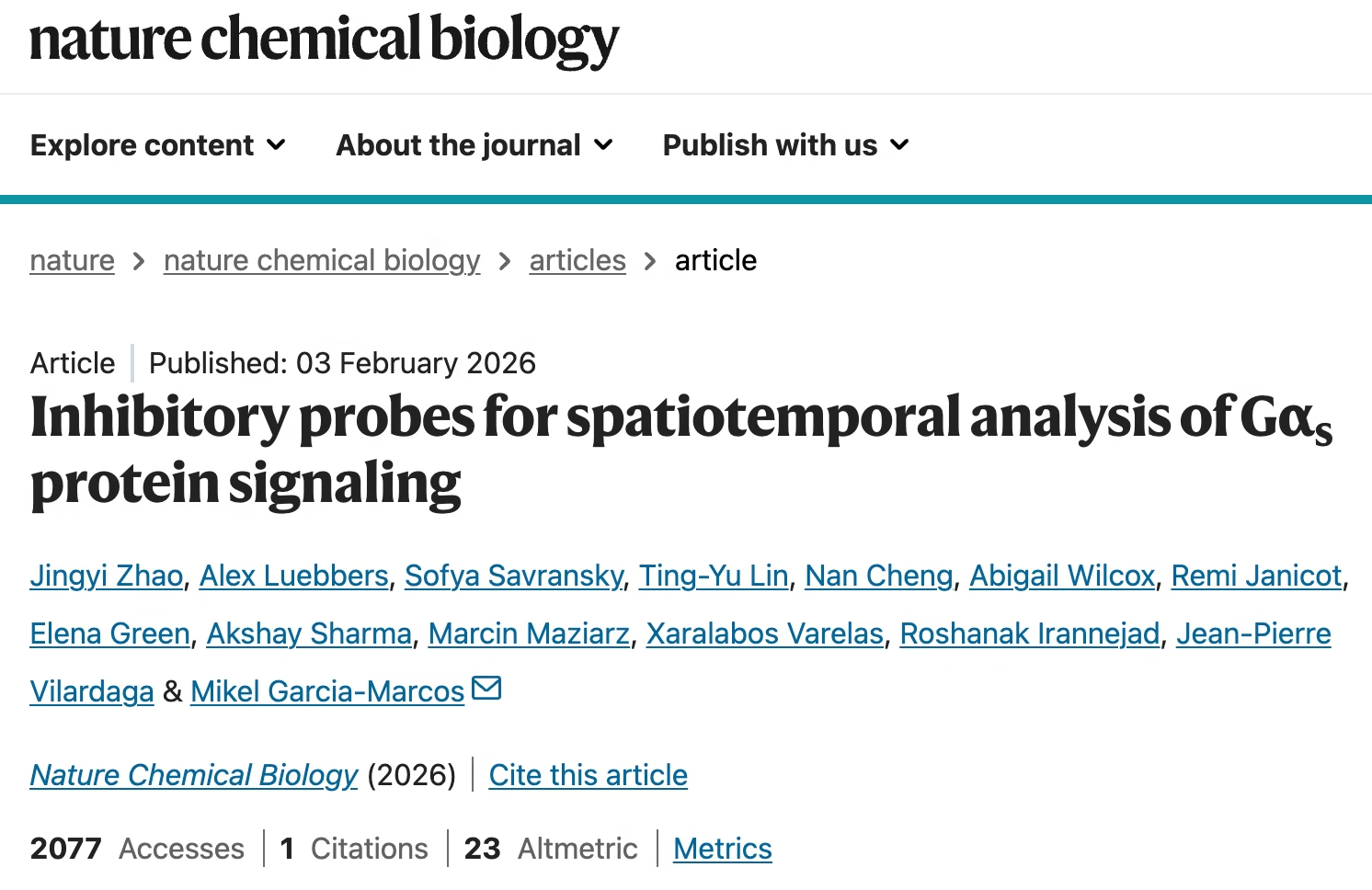
Inhibitory probes for spatiotemporal analysis of Gαs protein signaling
Key figures
- [Fig. 3a]: Demonstrates compartment-selective inhibition (endo-targeted inhibitor suppresses the sustained endosomal cAMP phase while sparing the early plasma-membrane phase).
- [Fig. 4c,e]: Shows that probe efficacy reports spatial accessibility (membrane-targeted inhibitor blocks endogenous GPCR-driven Gαs signaling, while cytosolic targeting does not) and reveals oncomutant-specific behavior.
- [Fig. 6b–d]: Validates a non-genetic, cell-penetrant cyclic inhibitor (α-sintide) that blocks Gαs outputs across receptors and in primary cardiac/immune cells.
1) Thesis (one sentence)
To address insufficient spatiotemporal tools to interrogate intracellular Gαs signaling, in GPCR-driven cAMP signaling in living cells, state-selective inhibitory probes (compartment-targeted GαsBP2 constructs and the cell-penetrant cyclic peptide α-sintide) cause compartment- and time-resolved suppression of downstream responses by competitively blocking the α3/SwII effector-binding groove of active Gαs, supported by live-cell BRET/FRET biosensors and functional phosphorylation/flow-cytometry assays.
2) Evidence card (three bullets only)
- Strongest result: Endosome-targeted GαsBP2 preferentially suppresses the sustained (post-washout) cAMP component attributed to endosomes, separating it from the early plasma-membrane component in PTH1R signaling. (Fig. 3a)
- Method enabler: A cell-penetrating cyclic peptide (α-sintide) functionally inhibits endogenous Gαs signaling across multiple native Gs-coupled receptors and extends inhibition into physiologically relevant primary cardiomyocytes and chronically activated human CD8+ T cells using luminescence cAMP assays, immunoblotting, and flow cytometry. (Fig. 6b–d; chemical biology tool + biosensors/flow)
- Critical limitation: Inhibition is strongly localization/access dependent (cytosolic targeting fails to block GPCR-activated endogenous Gαs unless the inhibitor is membrane-localized), so negative results can reflect probe mis-targeting or poor membrane proximity rather than absence of signaling. (Fig. 2e; Fig. 4e)
Optional
Quote bank (2–4 short excerpts)
- Quote 1: “However, progress on this topic has stalled because of insufficient approaches with adequate spatiotemporal resolution.” (Abstract, p. 1)
- Quote 2: “These findings pave the way to harnessing the spatiotemporal modulation of Gs signaling and its untapped therapeutic potential.” (Abstract, p. 1)
- Quote 3: “In conclusion, α-sintide efficiently prevents signaling triggered by diverse stimuli by specifically blocking Gαs.” (Results: α-Sintide blocks signaling by multiple Gs-coupled receptors, p. 10)
Key comparisons (1–3 lines)
- Compared to: GPCR antagonists or adenylyl cyclase modulators (and Gq/11 cyclic inhibitors like YM-254890/FR900359 discussed as analogs).
- Win: Direct, state-selective blockade at the Gαs effector interface with spatial (targeting) and temporal (recruitment) control options.
- Tradeoff: Practical performance depends on localization and (for α-sintide) micromolar dosing, which can constrain precision and scalability.
Methods I might copy (protocol hooks)
- Construct design / Models: HEK293T expression of GαsBP2 (SRELAWGISEWLEEWG) fused to mKate2 as (i) cytosolic via mas(G2A), (ii) plasma-membrane via Lyn11 (MGCIKSKGKDS), or (iii) endosomal via HA–2×FYVE (mouse Hrs FYVE domain); binding-deficient control GαsBP2-W11A; oncomutant Gαs-R201C and reduced-binding variants including S275L context; FRET sensor EPAC1CFP/YFP and luminescence sensor Glosensor 22F.
- Conditions / Instruments: For peptide delivery cAMP assays, add 2 µl of 100× peptide in DMSO to 200 µl cell suspension, incubate 2 h at 37 °C (water bath), equilibrate 10 min at 28 °C, add 200 µl of 5 mM D-luciferin in Tyrode’s buffer and incubate 15 min at 28 °C before luminescence; representative stimuli include isoproterenol 100 nM and forskolin 10 µM (cell assays) and PTH1–34 brief stimulation (1 min) for endosomal cAMP separation; α-sintide use examples include 100 µM (HEK293T), 10 µM pretreatment (mouse cardiomyocytes) with adrenaline 1 µM for 15 min, and 30 µM pretreatment (human CD8+ T cells) followed by PGE2 exposure (5 µM, 24 h).
- Readout / Analysis: Real-time cAMP via Glosensor luminescence (report as ALU and/or AUC); compartment-separated cAMP via EPAC1CFP/YFP FRET with quantification of “early” versus “sustained” components; cardiomyocyte signaling via pPLB/tPLB ratio from immunoblots; T-cell cytokine phenotypes via intracellular cytokine flow cytometry (e.g., IL-2+IFNγ+ and IL-2+TNF+ fractions).
Open questions / Theoretical implications (2–5 bullets)
- How broadly does active Gαs→effector coupling occur on non-endosomal organelles in intact cells, and what targeting domains best isolate those pools?
- Can membrane-association engineering of α-sintide (or analogous inhibitors) shift required dosing from micromolar toward sub-micromolar while preserving selectivity?
- To what extent do cancer-associated or compensatory mutations in/near the α3/SwII groove create resistance to effector-site blockers while preserving downstream signaling?
- Can recruitment-based temporal control (chemogenetic relocalization paradigms described in Extended Data) be replaced with faster, reversible control modalities to map rapid cAMP microdomain dynamics?
![Read more about the article [Paper Review #6] Lipid-mediated intracellular delivery of recombinant bioPROTACs for the rapid degradation of undruggable proteins](https://pharmphd.com/wp-content/uploads/2026/02/image-3-300x175.avif)
![Read more about the article [Paper Review #19] Accurate structure prediction of cyclic peptides containing unnatural amino acids using HighFold3](https://pharmphd.com/wp-content/uploads/2026/05/image-1-300x119.avif)
![Read more about the article [Paper Review #17] Artificial allosteric protein switches with machine-learning-designed receptors](https://pharmphd.com/wp-content/uploads/2026/04/image-3-300x114.avif)