https://www.pnas.org/doi/10.1073/pnas.1911154117
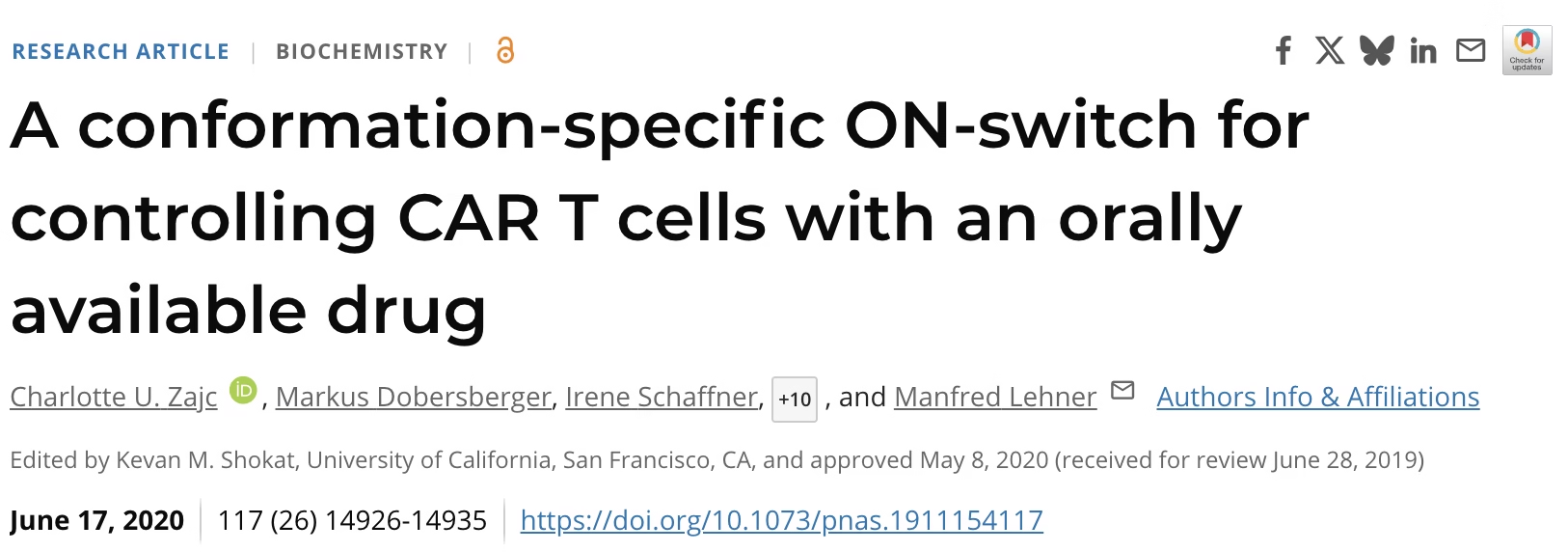
A conformation-specific ON-switch for controlling CAR T cells with an orally available drug
Key figures
- [Figure 2E]: Quantifies drug-dependent dynamic range (nanomolar ON vs micromolar OFF) and cross-validates switching by yeast display, ITC, and SPR.
- [Figure 4A–C]: Provides the 1.8-Å structural mechanism (RS3 reads A1120-induced loop conformations at the pocket entrance), explaining allosteric conformation specificity.
- [Figure 5B]: Shows real functional control—primary human ON-switch CAR T cells kill targets and secrete cytokines only with A1120.
1) Thesis (one sentence)
To address suboptimal clinically relevant conditional heterodimerization systems, in a lipocalin-gated CAR assembly platform, engineering binders that recognize A1120-loaded hRBP4 causes drug-controlled CAR assembly and T cell activation by allosterically reading ligand-induced loop conformations at the hRBP4 pocket entrance, supported by yeast-display selection, biophysical binding assays, X-ray crystallography, and cellular functional readouts.
2) Evidence card (three bullets only)
- Strongest result: A split ON-switch CAR (RS3 on signaling chain; hRBP4 fused to anti-CD19 scFv on a separate chain) shows A1120-dependent cytotoxicity and IFN-γ/IL-2 secretion, reaching levels comparable to a constitutive anti-CD19 CAR. (Fig. 5B)
- Method enabler: Positive selection (+A1120) plus negative selection (−A1120) in yeast display yields conformation-specific binders from two scaffolds (rcSso7d and FN3), with KD shifts quantified consistently by flow cytometry titrations, ITC, and SPR. (Fig. 2A–E; protein engineering + yeast surface display/flow cytometry + ITC/SPR)
- Critical limitation: The OFF-state is not truly “zero”—ITC/SPR report micromolar KD values without A1120 (e.g., RS3 ~2.7–5.5 µM), so high effective local concentrations (e.g., membrane proximity/secretory pathway) could create leak via residual association. (Fig. 2E)
Optional
Quote bank (2–4 short excerpts)
- Quote 1: “In this study, we present an ON-switch system based on human retinol binding protein 4 (hRBP4) and the orally available small molecule A1120.” (Abstract, p.14926)
- Quote 2: “The crystal structure of the assembled ON-switch showed that the engineered binder specifically recognizes A1120-induced conformational changes in hRBP4.” (Abstract, p.14926)
- Quote 3: “Thus, the potency of A1120 to turn on the hRBP4-based molecular ON-switch closely matches its ability to trigger T cell signaling in a CAR molecule.” (Results, p.14932)
Key comparisons (1–3 lines)
- Compared to: FRB/FKBP (rapamycin/rapalogs) and BCL-xL/ABT-737-style CID switches discussed as baselines for pharmacologic control of protein interactions/CARs.
- Win: Allosteric, conformation-specific recognition of a human lipocalin state enables high orthogonality against other hRBP4 ligands and avoids direct small-molecule epitope recognition.
- Tradeoff: Switch performance depends on saturating hRBP4 with drug in vitro (5 µM used throughout), and the most A1120-dependent scaffold in this study is nonhuman (rcSso7d) with micromolar OFF-state binding.
Methods I might copy (protocol hooks)
- Construct design / Models: Two-chain CAR design: chain I contains RS3 on a second-generation CAR backbone with an extracellular IgG1-Fc spacer and intracellular CD28TM/CD28 costim/CD3ζ domains; chain II contains hRBP4 fused to an anti-CD19 scFv with an IgG1-Fc spacer and lacks a transmembrane domain, requiring capture by chain I for assembly. Primary human T cells and dual-reporter Jurkat cells were electroporated with mRNAs encoding the CAR chains and tested against CD19+ NALM6 (luciferase) or CD19-transfected Jurkat targets.
- Conditions / Instruments: A1120 used at 5 µM unless indicated (chosen to saturate hRBP4; described as ~600-fold above a literature KD); ITC on PEAQ ITC Automated with 10 µM hRBP4 in the cell and 100 µM binder titrant in PBS pH 7.4, ±50 µM A1120, 1 µL injections; SPR on Biacore T200 (CM5, amine coupling) with hRBP4 at 20 µg/mL in 10 mM sodium acetate pH 4 immobilized to 500 RU at 30 µL/min and HBS-EP running buffer, single-cycle kinetics (association 60 s, dissociation 60 s, 30 µL/min), plus A1120 titration 0–4,374 nM (30 min equilibration; 5 min association with 100 nM RS3; regeneration with 4 M MgCl2 for 60 s at 30 µL/min); DSC on PEAQ DSC with 80 µM binder heated 20–110 °C at 1 °C/min (non-two-state unfolding fit).
- Readout / Analysis: Yeast binding by flow cytometry (MFI titrations fit to a 1:1 model for KD); primary CAR T cytotoxicity in 96-well round-bottom plates for 4 h at 37 °C (E:T 2:1) ±5 µM A1120, with luciferin (150 µg/mL) and luminescence read after 20 min on an EnSpire Multimode plate reader; dual-reporter Jurkat NFAT/NFκB readout after 20 h coculture (E:T 1:2) by flow cytometry with EC50 fits by nonlinear regression (variable slope) in GraphPad.
Open questions / Theoretical implications (2–5 bullets)
- How general is the “allosteric state readout” principle across other lipocalins with ligand-dependent loop motions and different drug chemotypes?
- What is the practical orthogonality limit when the binder recognizes a conformational state (risk: an untested ligand could mimic the A1120-induced loop state)?
- Can a fully human binder scaffold reach rcSso7d-like A1120 dependence without sacrificing affinity/stability, reducing immunogenicity concerns?
- Given micromolar OFF-state KD values, what component geometry/compartmentalization rules are required to suppress leak in high-effective-concentration settings?
![Read more about the article [Paper Review #24] Discovery of Covalent Ligands with AlphaFold3](https://pharmphd.com/wp-content/uploads/2026/06/image-2-300x90.avif)
![Read more about the article [Paper Review #21] Cyclic peptide structure prediction and design using AlphaFold2](https://pharmphd.com/wp-content/uploads/2026/05/image-3-300x108.avif)
![Read more about the article [Paper Review #32] Biomolecular design through latent reasoning with RFD4-Proteina](https://pharmphd.com/wp-content/uploads/2026/10/pharmphd-7993efeebcaafaf9e840-300x164.avif)