https://www.nature.com/articles/s41589-025-01929-w
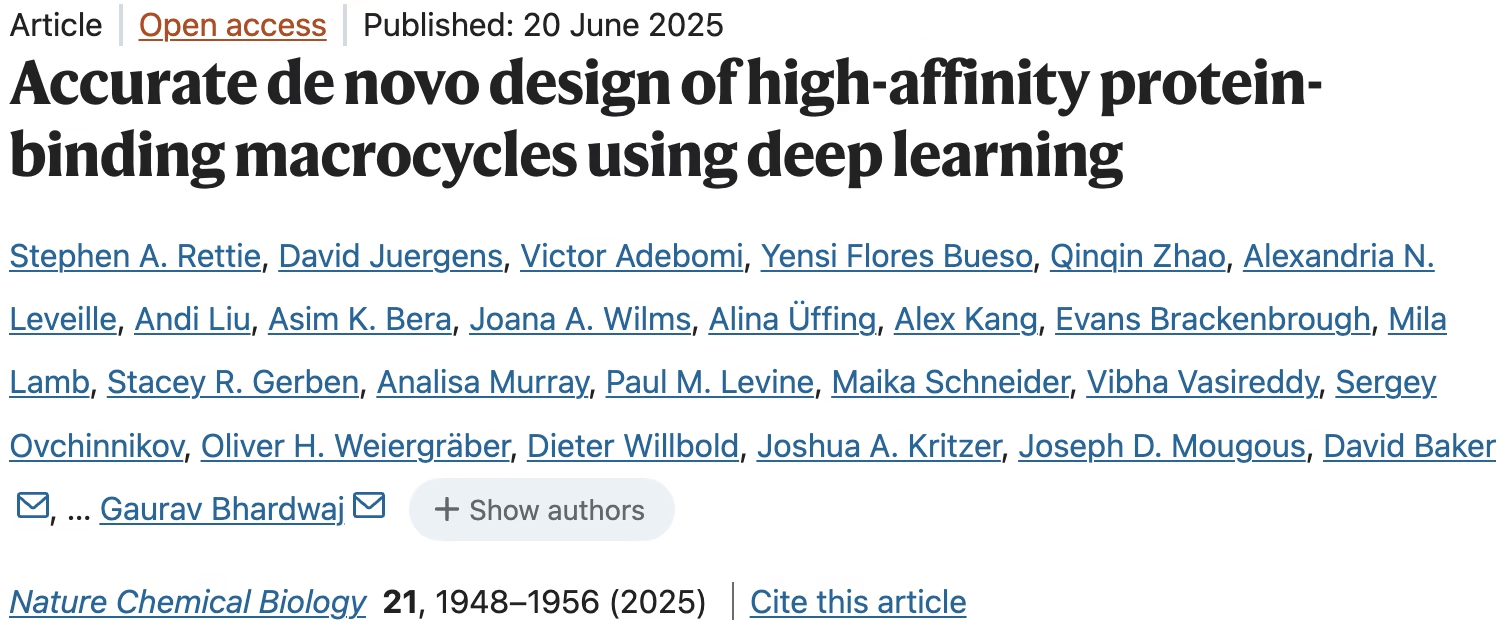
Accurate de novo design of high-affinity protein-binding macrocycles using deep learning
Key figures
- [Figure 1]: Defines RFpeptides as cyclic-offset RFdiffusion plus ProteinMPNN, AfCycDesign, and Rosetta, and validates that generated macrocycles are diverse and self-consistent.
- [Figure 2]: Shows micromolar MCL1 and MDM2 binders and confirms MCB_D2 atomic accuracy by X-ray structure at 0.7 Å target-aligned macrocycle RMSD.
- [Figure 3]: Demonstrates nanomolar GABARAP binders GAB_D8 and GAB_D23 with SPR, AlphaScreen competition, and co-crystal structures close to design models.
- [Figure 4]: Extends the method to a predicted, flat RbtA surface and validates RBB_D10 at 9.4 nM with an X-ray complex matching design.
- [Supplementary Figure 4]: Establishes the target-dependent computational score distributions used for iPAE, Rosetta ddG, and contact molecular surface filtering.
- [Supplementary Figure 14]: Reveals a concrete structural caveat: GAB_D8 can occupy a secondary conformation/register-shifted state in the crystal lattice.
1) Thesis (one sentence)
To address the absence of robust de novo methods for protein-binding macrocycles, in four structurally diverse protein targets, RFpeptides causes medium- to high-affinity macrocycle binding with near-atomic design accuracy by combining cyclic RFdiffusion backbone generation, ProteinMPNN sequence design, AfCycDesign/RF2 structure prediction, and Rosetta interface filtering, supported by SPR, AlphaScreen, and X-ray crystallography.
2) Evidence card (three bullets only)
- Strongest result: (Fig. 3; Fig. 4) GAB_D8 bound GABARAP at 6.0 nM and inhibited GABARAP–K1 with 0.656 nM IC50, while RBB_D10 bound a predicted flat RbtA surface at 9.4 nM and matched the X-ray complex at 1.4 Å target-aligned macrocycle RMSD.
- Method enabler: (Fig. 1; Supplementary Fig. 4; computational de novo design plus biophysical/structural validation using RFdiffusion, ProteinMPNN, AfCycDesign/RF2, Rosetta, SPR, AlphaScreen, and X-ray crystallography) Cyclic relative positional encodings made RFdiffusion sample head-to-tail macrocycle backbones, then orthogonal structure prediction and interface metrics enriched designs before synthesis.
- Critical limitation: (Supplementary Fig. 4; Supplementary Fig. 14; Supplementary Tables 1b–4b) The iPAE/ddG/CMS/SAP filters required target-specific thresholds and did not perfectly rank experimental affinity, while GAB_D8 showed an alternate bound conformer/register shift in one crystal state.
Optional
Quote bank (2–4 short excerpts)
- Quote 1: “RFpeptides provides a framework for rapid and custom design of macrocyclic peptides for diagnostic and therapeutic applications.” (Abstract, page 1)
- Quote 2: “Information on known ligands and/or binding partners is not required to initiate design.” (Discussion, page 8)
- Quote 3: “Notably, combining DL-based and physics-based in silico filters helps to select medium to high-affinity binders.” (Results, page 8)
Key comparisons (1–3 lines)
- Compared to: Display-library screening, natural-product discovery, and earlier motif-borrowing computational peptide design.
- Win: Tested fewer than 20 designs per target yet recovered binders for all four targets, including nanomolar binders and X-ray-validated design models near 1.5 Å.
- Tradeoff: Direct binders still depend on synthesis/cyclization feasibility and empirical filtering thresholds; intracellular activity, permeability, and conditional binding were not demonstrated.
Methods I might copy (protocol hooks)
- Construct design / Models: Apply cyclic relative positional encoding to the diffused peptide chain while keeping target/interchain encodings standard; generate RFdiffusion backbones with diffuser.T=50; explore 16 aa for MCL1, 16–18 aa for MDM2, and 12–18 aa for GABARAP/RbtA; design four sequences per backbone through iterative ProteinMPNN/Rosetta FastRelax; omit cysteine; repredict complexes with AfCycDesign/RF2; filter by normalized iPAE, Cα RMSD, Rosetta ddG, SAP, and CMS.
- Conditions / Instruments: Use Cytiva Biacore 8K SPR in HBS-EP+ at 30 µL/min with biotinylated target capture; screening injections were 10 nM, 100 nM, 1 µM, 10 µM, and 100 µM with 60 s association and 120 s dissociation, except MCL1 used 150 s dissociation; affinity runs used nine-point single-cycle kinetics with 90 s association and 300 s dissociation.
- Readout / Analysis: Analyze SPR in Biacore Insight with double-referenced sensorgrams and 1:1 binding kinetics; for GABARAP AlphaScreen, use 10 nM biotin-K1, 10 nM 6xHis-GABARAP, 50 µL reaction volume, 1:3 inhibitor dilution from 50 µM, 25 mM HEPES pH 7.3, 150 mM NaCl, 0.01% Tween, 1 mg/mL BSA, 0.5% DMSO, 150 min incubation, 45 min bead incubation, Tecan 680 nm excitation and 520–620 nm emission, and GraphPad Prism IC50 fitting.
Open questions / Theoretical implications (2–5 bullets)
- Can cyclic-offset diffusion be generalized from binary macrocycle-target binding to three-body, ligand-conditioned proximity?
- Does pre-folded macrocycle design translate to intracellular potency once permeability, proteolysis, and target engagement in crowded cellular environments are imposed?
- Can target-specific in silico thresholds be learned prospectively, or will each new surface class require empirical calibration?
- Can all-atom/noncanonical extensions introduce warheads, crosslinkers, and small-molecule handles without losing structural accuracy?
![Read more about the article [Paper Review #21] Cyclic peptide structure prediction and design using AlphaFold2](https://pharmphd.com/wp-content/uploads/2026/05/image-3-300x108.avif)
![Read more about the article [Paper Review #3] Inhibitory probes for spatiotemporal analysis of Gαs protein signaling](https://pharmphd.com/wp-content/uploads/2026/02/image-300x195.avif)
![Read more about the article [Paper Review #22] Recognition and reprogramming of E3 ubiquitin ligase surfaces by α-helical peptides](https://pharmphd.com/wp-content/uploads/2026/05/image-4-300x89.avif)