https://www.nature.com/articles/s41598-025-20608-3
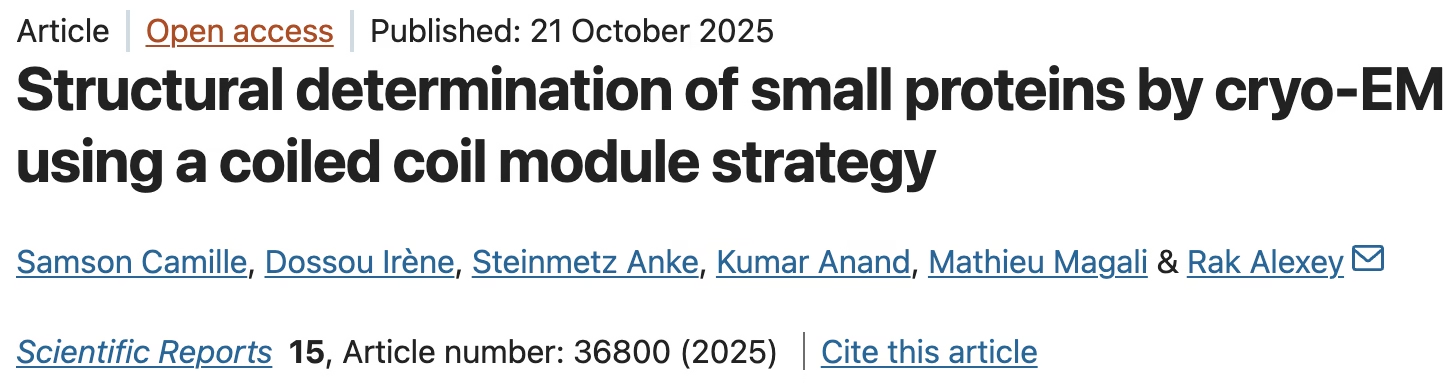
Structural determination of small proteins by cryo-EM using a coiled coil module strategy
Key figures
- Figure 1: Explains the APH2 coiled-coil fusion design, including direct shared-helix fusion in CC2 and Htt-linker fusion in CC3, plus predicted nanobody-bound assemblies.
- Figure 3: Shows that the CC2-Nb26 assembly can be reconstructed by cryo-EM at 3.77 Å after heterogeneous, non-uniform, and local refinement.
- Figure 4: Demonstrates the main structural result by resolving kRasG12C with GDP and covalent MRTX849 density in the CC2-APH2-Nb26 scaffold.
1) Thesis (one sentence)
To address the gap of routine cryo-EM structure determination for small therapeutic proteins, in kRasG12C fused to modular helical scaffolds, APH2 coiled-coil fusion with nanobody recruitment causes atomic-detail reconstruction of a 70 kDa scaffolded kRasG12C complex by increasing effective particle size and stabilizing a C2-symmetric helical assembly, supported by construct design, DSF, SEC-HPLC, cryo-EM reconstruction, density fitting, and ligand-density evidence.
2) Evidence card (three bullets only)
- Strongest result: (Fig. 4) The CC2-APH2-Nb26 strategy resolved kRasG12C at a global resolution of about 3.7 Å, with GDP, MRTX849, Mg2+, and the covalent Cys12-MRTX849 linkage visible in the cryo-EM map, while the MRTX849 pose matched the prior X-ray structure PDB 6UT0.
- Method enabler: (Fig. 1, Fig. 3; structural biology + cryo-EM scaffold engineering) The enabling strategy was continuous alpha-helical fusion of the kRas C-terminal helix to the APH2 coiled-coil motif, followed by nanobody recognition of APH2, cryoSPARC processing, heterogeneous refinement, non-uniform refinement, local refinement, rigid-body fitting in UCSF Chimera, manual adjustment in Coot, and real-space refinement in PHENIX.
- Critical limitation: (Fig. 2, Fig. 4, Discussion) The method depends on a suitably rigid terminal helix, and residual flexibility remained substantial: one kRas copy in CC3 was not clearly visible, kRas Switch II residues 61-76 were unresolved in CC2, and the TEAD2 BC2-tag strategy failed because tag fusion introduced excessive flexibility.
Optional
Quote bank (2–4 short excerpts)
- Quote 1: “Cryo-EM has traditionally been used for structural determination of proteins larger than 50 kDa.” (Abstract, page 1)
- Quote 2: “The kRasG12C structure was bound to the inhibitor drug MRTX849 and GDP” (Abstract, page 1)
- Quote 3: “the Switch regions, which remain flexible unless constrained in crystal contacts” (Discussion, page 11)
- Quote 4: “the current coiled-coil approach and its possible variations should make cryo-EM structure determination of small proteins a routine method.” (Discussion, page 11)
Key comparisons (1–3 lines)
- Compared to: Phase plates, oligomeric scaffold fusion, BRIL or Fab scaffolds, DARPin cages, megabodies, Legobodies, and tag-based nanobody recruitment.
- Win: APH2 fusion provides a modular size-increase strategy with minimal target engineering when the target has a usable terminal helix, and it can exploit existing APH2-binding nanobodies.
- Tradeoff: The scaffold does not automatically rigidify flexible target regions, and proteins lacking terminal helices may require indirect binders or internal epitope insertion, increasing engineering burden.
Methods I might copy (protocol hooks)
- Construct design / Models: kRasG12C C-terminal helix was fused to APH2 as CC1, CC2, and CC3; CC2 used a shared-helix method in which two turns of the kRas C-terminal helix were superimposed on two turns of the APH2 N-terminal helix, retaining kRas His166/Lys167 and APH2 Leu1/Glu4/Leu5; CC3 connected kRas to APH2 through Htt residues 5-18 as a helical linker; APH2-nanobody starting models used PDB 7A50, 7A4D, and 7A48, and kRasG12C-MRTX849-GDP used PDB 6UT0.
- Conditions / Instruments: Proteins were cloned into a Sanofi expression vector with C-terminal His6 where applicable, expressed in E. coli BL21 DE3 Star in LB auto-inducible medium with 30 mg/L kanamycin at 28 °C, lysed in 25 mM Tris-HCl pH 7.5, 500 mM NaCl, 1 mM TCEP, and protease inhibitor, purified by HisTrap FF crude column with 0-500 mM imidazole, then SEC on Superdex 75 or 200; MRTX849 complexes used CC2 or CC3 at 10 mg/mL with 5 mM MgCl2 and fivefold molar excess MRTX849 for 48 h at 37 °C; cryo-EM grids used 0.7 mg/mL purified complexes on glow-discharged Quantifoil R1.2/1.3 300 mesh gold grids, vitrified on Vitrobot Mark IV at 4 °C; data were collected on a 200 kV Glacios with Falcon4 detector, EPU 2.9, defocus -0.8 to -2.2 μm, pixel size 0.58 Å.
- Readout / Analysis: DSF measured CC1 and CC2 stability with 0.5 mg/mL protein and 20X SYPRO Orange from 20 °C to 90 °C at 0.12 °C/min on Bio-Rad CFX96; HPLC used S200 10/300 with 20 mM HEPES pH 7.4, 150 mM NaCl, 1 mM TCEP, 2 mM MgCl2 over 50 min at 0.05 mL/min; cryoSPARC 4.5.3 processing included patch motion correction, patch CTF, Topaz picking, 2D classification, ab initio reconstruction, heterogeneous refinement, non-uniform refinement, and local refinement; final CC2-Nb26 model quality was MolProbity 2.22 with 95.34% Ramachandran favored.
Open questions / Theoretical implications (2–5 bullets)
- Can APH2 fusion be generalized to non-Ras small GTPases that have terminal helices or engineered helical extensions without disrupting effector interfaces?
- Would engineered cross-links such as i to i+11 helix stabilization improve scaffold rigidity enough to resolve flexible switch regions in small GTPases?
- Can an APH2-like module be used as a removable cryo-EM fiducial for validating designed ternary complexes without biasing the target-binding surface?
- For small GTPases, does scaffold attachment at the C-terminal helix preserve enough native conformational dynamics to support ligand-bound and nucleotide-state-specific interpretation?
![Read more about the article [Paper Review #29] The Bump-and-Hole Tactic: Expanding the Scope of Chemical Genetics](https://pharmphd.com/wp-content/uploads/2026/07/image-7-300x145.avif)
![Read more about the article [Paper Review #3] Inhibitory probes for spatiotemporal analysis of Gαs protein signaling](https://pharmphd.com/wp-content/uploads/2026/02/image-300x195.avif)
![Read more about the article [Paper Review #22] Recognition and reprogramming of E3 ubiquitin ligase surfaces by α-helical peptides](https://pharmphd.com/wp-content/uploads/2026/05/image-4-300x89.avif)