https://www.nature.com/articles/s41467-022-28507-1
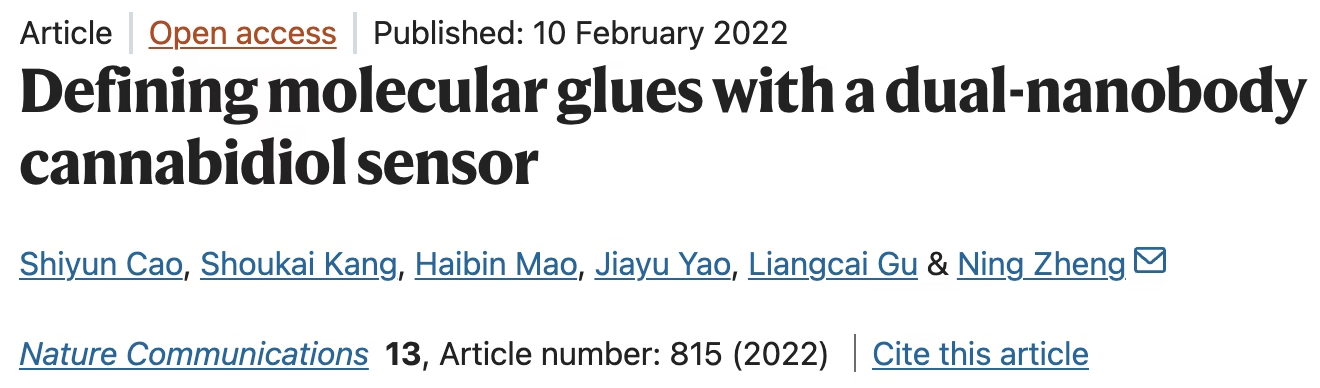
Defining molecular glues with a dual-nanobody cannabidiol sensor
Key figures
- Figure 6: Extends the CBD and auxin logic to canonical IMiD systems by showing that CRBN already has measurable intrinsic affinity for IKZF1 and CK1α before ligand addition, which is central to the paper’s definition of molecular glues.
- Figure 7: Formalizes the thermodynamic model for molecular glues, explains the trapped-topology regime, and shows why MG dose-response curves are sigmoidal rather than hook-shaped.
- Figure 4: Mutating DB21 residues that contact CBD weakens ligand-enabled complex formation without strongly changing intrinsic CA14:DB21 affinity, directly supporting the mechanism that the ligand complements the protein-protein interface.
1) Thesis (one sentence)
To address the gap of how to define molecular glues thermodynamically, in the dual-nanobody CBD sensor together with auxin and IMiD reference systems, structural and quantitative dissection causes a unified molecular-glue framework by showing that ligand enhances a pre-existing weak protein-protein interaction to form a high-affinity ternary complex without detectable ligand binding to one partner, supported by crystallographic, mutational, ITC, BLI, AlphaScreen, and mathematical-modeling evidence.
2) Evidence card (three bullets only)
- Strongest result: (Fig. 6; Table 1) The paper shows that IMiD systems fit the same core thermodynamic logic as the CBD and auxin systems: IKZF1 binds DDB1-CRBN with intrinsic 223 to 285 nM affinity and is strengthened to 53 to 67 nM by pomalidomide, while CK1α binds at 2.3 μM and is strengthened to 75 nM by lenalidomide, supporting the claim that molecular glues act on protein pairs with pre-existing affinity rather than creating interaction from nothing.
- Method enabler: (Fig. 1, Fig. 3, Fig. 7; structural biology + biophysics + modeling) A 2.0 Å crystal structure of the CA14-CBD-DB21 ternary complex, combined with ITC, BLI, AlphaScreen, mutagenesis, and a three-body equilibrium model, enabled the authors to connect physical interface geometry to measurable parameters such as K_d1, K_d2, K_d3, cooperativity, and EC50.
- Critical limitation: (Fig. 4) CA14 remained refractory to crystallization, so the authors could not directly visualize whether CBD also preorganizes CA14 for DB21 binding, meaning their conclusion that the CBD-DB21 interface is the dominant driver rests on indirect mutational evidence rather than an apo/holo structural comparison.
Optional
Quote bank (2–4 short excerpts)
- Quote 1: “These two unifying features define MGs as a special class of proximity inducers distinct from bifunctional compounds” (Abstract, page 1)
- Quote 2: “Auxin and CBD, therefore, represent a class of topologically trapped MGs.” (Results, page 10)
- Quote 3: “MG molecules rely on positive cooperativity to function.” (Results, page 10)
Key comparisons (1–3 lines)
- Compared to: Bifunctional proximity inducers such as PROTACs.
- Win: MGs can act even when the ligand has no detectable affinity for one partner, provided there is measurable intrinsic protein-protein affinity and positive cooperativity; in the trapped regime they also avoid the hook effect.
- Tradeoff: Their action is constrained by needing a pre-existing weak protein-protein interaction and, in the CBD/auxin examples, a topology where the ligand becomes buried at the interface.
Methods I might copy (protocol hooks)
- Construct design / Models: CA14 and DB21 nanobodies were expressed with N-terminal pelB-His tags for periplasmic expression in E. coli; an Avi-tag was added after the TEV site for biotinylated DB21; purified CA14, DB21, and CBD were assembled at a 1:1:1.2 molar ratio and concentrated to 10 to 20 mg/mL for crystallization; IKZF1 used the ZF2-3 fragment residues 141 to 196; CRBN used CRBNΔ1-40 with full-length DDB1.
- Conditions / Instruments: Crystals were grown at 25 °C by hanging-drop vapor diffusion using 0.1 μL protein plus 0.1 μL reservoir containing 0.2 M ammonium citrate tribasic pH 7.0, 0.1 M imidazole pH 7.0, and 20% PEG monomethyl ether 2000; diffraction was collected at BL8.2.1 at the Advanced Light Source; ITC used a MicroCal PEAQ-ITC at 25 °C with 18 injections of 2 μL while stirring at 750 rpm; BLI used Octet Red 96 at 30 °C with 200 nM biotinylated probe proteins and 200 μM ligand for saturating conditions; binding buffer was 25 mM HEPES pH 7.4, 100 mM NaCl, 0.1% Tween-20, 0.05 mg/mL BSA, plus 1 mM TCEP except for CA14-DB21 binding.
- Readout / Analysis: ITC, BLI kinetic and steady-state fits, AlphaScreen competition assays on an EnSpire reader, MG dose-response measurements with triplicates, nonlinear fitting in Prism 7, and structural rebuilding with Phaser-MR, COOT, and PHENIX.
Open questions / Theoretical implications (2–5 bullets)
- Can the weak pre-existing affinity criterion be used prospectively to choose target pairs for molecular-glue discovery rather than only retrospectively explain known cases?
- How general is the topologically trapped regime outside systems where the ligand is almost fully buried at the protein interface?
- For engineered chemically induced proximity systems, when does failure reflect insufficient ligand complementarity versus insufficient baseline protein-protein affinity?
- Could cooperativity-guided optimization outperform affinity-only optimization when evolving synthetic conditional binders?
![Read more about the article [Paper Review #22] Recognition and reprogramming of E3 ubiquitin ligase surfaces by α-helical peptides](https://pharmphd.com/wp-content/uploads/2026/05/image-4-300x89.avif)
![Read more about the article [Paper Review #13] Predicting the protein interaction landscape of a free-living bacterium with pooled-AlphaFold3](https://pharmphd.com/wp-content/uploads/2026/03/image-7-300x111.avif)
![Read more about the article [Paper Review #27] Single-Sequence Deep Learning Delivers Crystal-Quality Models of Covalent K-Ras G12 Hotspot Complexes](https://pharmphd.com/wp-content/uploads/2026/07/image-5-300x129.avif)