https://www.pnas.org/doi/10.1073/pnas.2210435119
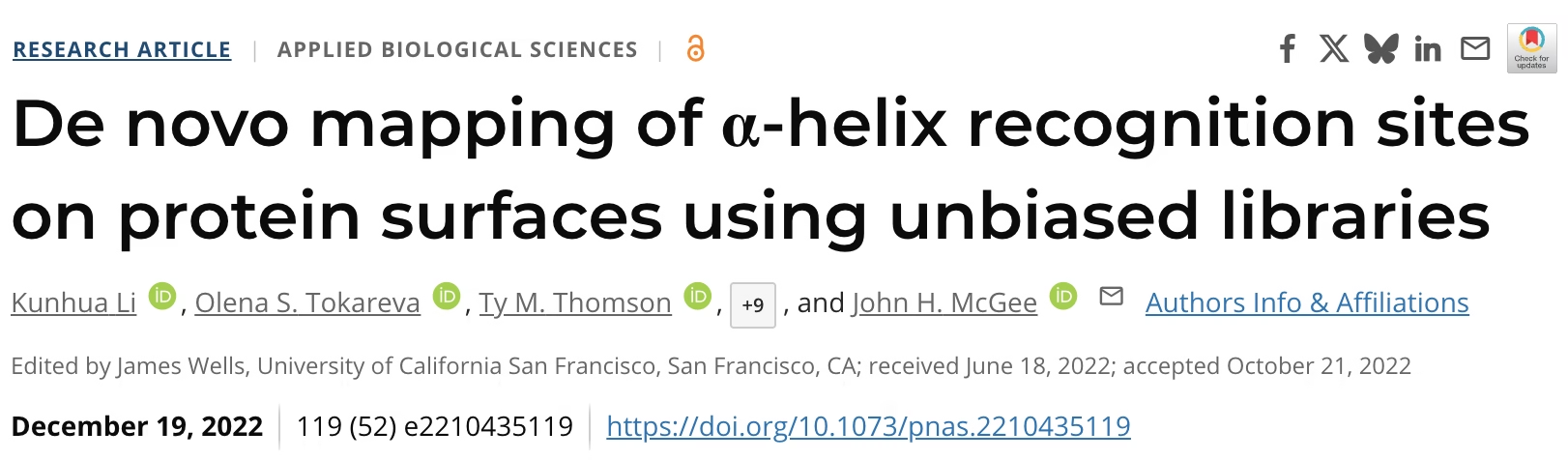
De novo mapping of α-helix recognition sites on protein surfaces using unbiased libraries
Key figures
- Figure 1: Establishes that N,N′-(1,4-phenylene)bis(2-bromoacetamide) cysteine stapling increases α-helical structure across diverse 14-mer Helicons.
- Figure 2: Defines the single-round, spike-in-normalized phage display and NGS workflow that enables parallel comparison of many target, ligand-bound, competitor-bound, and blank-bead conditions.
- Figure 3: Shows that unbiased Helicon libraries rediscover the natural β-catenin Axin site, identify shifted/flipped binding modes, and reveal a new ICAT-like α-helical binding site.
- Figure 4: Demonstrates that RNF31 screens find multiple binding solutions, including distinct PUB-domain modes and an induced-fit rearrangement of the UBA domain.
- Figure 5: Shows that Helicons can bind allosteric CDK2 surfaces with CDK2/CDK1 selectivity and orthosterically inhibit PPIA by occupying the CsA/substrate site.
- Figure 6: Shows that PD-L1-binding Helicons can block the PD-L1:PD-1 interface and that FP28132 induces PD-L1 dimerization in solution.
- Supplementary Table S2: Quantifies the cell-associated fraction and retained β-catenin activity of hydrocarbon-stapled C35 analogs, exposing the translation gap between phage hits and cell-compatible binders.
- Supplementary Figure S7: Confirms electron density for the Helicon-bound structures used to validate side-chain-mediated α-helix recognition across targets.
1) Thesis (one sentence)
To address the lack of a general route to discover α-helical binders for proteins without known helix-recognition sites, in six structurally diverse protein domains, unbiased cysteine-stapled Helicon phage display causes de novo mapping of α-helix recognition sites and discovery of functional binders by single-round bead selection, spike-in-normalized NGS, sequence clustering, and biochemical/structural validation, supported by SPR, fluorescence polarization, enzymatic assays, ELISA, TR-FRET, cell-association MS, and X-ray co-crystal structures.
2) Evidence card (three bullets only)
- Strongest result: (Fig. 6) PD-L1 Helicon FP28132 bound the PD-1 interaction surface, inhibited PD-L1:PD-1 binding in competition ELISA, and induced PD-L1 dimerization by TR-FRET, extending the platform to an extracellular domain not previously known to bind α-helices.
- Method enabler: (Fig. 2; Supplementary Fig. S2; research type + tools) Experimental platform development using cysteine-stapled M13 phage display, ~10^8-member naive libraries, single-round bead selection, spike-in-normalized NGS, hierarchical clustering, SPR, FP, enzymology, ELISA/TR-FRET, MS cell-association analysis, and X-ray crystallography.
- Critical limitation: (Fig. 2; Supplementary Table S2) The multivalent M13 phage format can inflate apparent binding through avidity, and cell-associated hydrocarbon-stapled C35 analogs were only shown for β-catenin with many analogs retaining weak TCF-competition activity (>10 µM IC50) despite measurable cell association.
Optional
Quote bank (2–4 short excerpts)
- Quote 1: “no general method for discovering α-helical binders to proteins has been reported” (Abstract, page 1)
- Quote 2: “the constructed library explores roughly 0.01% of the theoretical sequence space for this design.” (Results, page 3)
- Quote 3: “These conserved positions are strongly predictive of which residues are forming direct binding interactions with the protein target.” (Results, page 4)
- Quote 4: “many of these sites are located on surfaces not previously known to bind α-helices.” (Discussion, page 9)
Key comparisons (1–3 lines)
- Compared to: Rational Helicon design from known natural helices, conventional multi-round phage panning, and small-molecule/antibody discovery.
- Win: Does not require preexisting structural information or known helical binders, and the same screen can incorporate target concentration, competitor, ligand-state, posttranslational-modification, and blank-bead controls.
- Tradeoff: The screen maps recognition sites and starting chemotypes, but potency, monovalent affinity, cellular uptake, and functional activity require separate optimization.
Methods I might copy (protocol hooks)
- Construct design / Models: Naive library sequence was ADPAxxxCxxAAxxCxxx displayed as an N-terminal fusion to M13 pIII, with an N-DPAA-C helix-nucleating cap, i/i+7 cysteines, two central alanines to reduce staple clash, 10 randomized positions, and an 8-residue glycine-rich linker to pIII. Randomization used trimer phosphoramidites for 16 amino acids, excluding cysteine, lysine, proline, and glycine. Target constructs included β-catenin residues 134-665, RNF31 PUB residues 1-179, RNF31 UBA residues 480-639, CDK2 residues 1-298, PPIA residues 1-165, and PD-L1 ECD constructs including residues 18-134 for crystallography and residues 18-239 for biochemical assays.
- Conditions / Instruments: Peptide stapling used 100 µmol Fmoc SPPS on Rink amide resin, cleavage with 92.5% TFA/2.5% water/2.5% triisopropylsilane/2.5% mercaptopropionic acid for 2 h, cysteine bisalkylation in 2:1 acetonitrile/50 mM ammonium hydroxide at pH ~8.5 with 1.3 equivalents crosslinker, and HPLC/MS purification. On-phage stapling used phage in TBS at OD600 1.0, 1 mM DTT, dialysis against 100 volumes of 20 mM NH4CO3/2 mM EDTA pH ~8 for 30-60 min, 200 µM crosslinker for 2 h at 32 °C, 0.25 mM DTT for 10 min, 0.75 mM iodoacetamide for 10 min, and storage in 50% glycerol/TBS at -80 °C at >10^12 pfu/mL. Phage screening used 10^10 phage particles per condition, bead depletion for 1 h at room temperature, 100 µL of 2 µM biotinylated target captured on 0.5 mg Dynabeads, 200 µL final binding reactions, 45 min room-temperature incubation with rotation, and 5x ice-cold washes.
- Readout / Analysis: NGS used a 95 °C, 15 min bead-denaturation step in 25 mM Tris pH 8, 50 mM NaCl, 0.5% Tween-20, plus 10,000 spike-in phage copies per well before boiling and Illumina NovaSeq 2×150 sequencing. Reads were filtered at Phred score ≥18 and library-design match, normalized to spike-in counts, assigned Hit Strength as highest-target normalized counts over blank-bead normalized counts with a 0.5 pseudocount for blank zeros, and clustered when Hit Strength >5 using average-linkage hierarchical clustering with modified BLOSUM62. β-catenin SPR used Biacore 8K at 25 °C with 50 mM Tris pH 8.0, 300 mM NaCl, 2% glycerol, 0.5 mM TCEP, 0.5 mM EDTA, 0.005% Tween-20, 1% DMSO; peptide top concentration 10 or 1 µM; 180 s association; 400 s dissociation. Cell-association MS used Expi293 cells at 1×10^6 cells/mL, 22 h incubation at 37 °C and 8% CO2, two DPBS washes, ammonium hydroxide lysis, SpeedVac drying, and LC-MS quantification against cell-free calibration.
Open questions / Theoretical implications (2–5 bullets)
- Can sequence-logo conservation from phage clusters serve as a practical substitute for early SAR before co-crystal structures are available?
- How often do productive α-helical binders exploit true native-like pockets versus transient induced-fit surfaces that may be difficult to preserve in cells?
- What display valency best balances weak-hit detection against affinity inflation from avidity?
- Can shift/flip cluster logic be turned into a computational rule for redesigning Helicons or grafting pharmacophores into larger protein scaffolds?
- Which target classes tolerate Helicon-induced conformational rearrangement without creating nonphysiological artifacts?
![Read more about the article [Paper Review #10] A conformation-specific ON-switch for controlling CAR T cells with an orally available drug](https://pharmphd.com/wp-content/uploads/2026/03/image-1-300x106.avif)
![Read more about the article [Paper Review #26] Computational design of conformation-biasing mutations to alter protein functions](https://pharmphd.com/wp-content/uploads/2026/07/image-4-300x89.avif)
![Read more about the article [Paper Review #15] Rapid search for tertiary fragments reveals protein sequence–structure relationships](https://pharmphd.com/wp-content/uploads/2026/04/image-1-300x112.avif)