https://www.nature.com/articles/s41589-025-02051-7
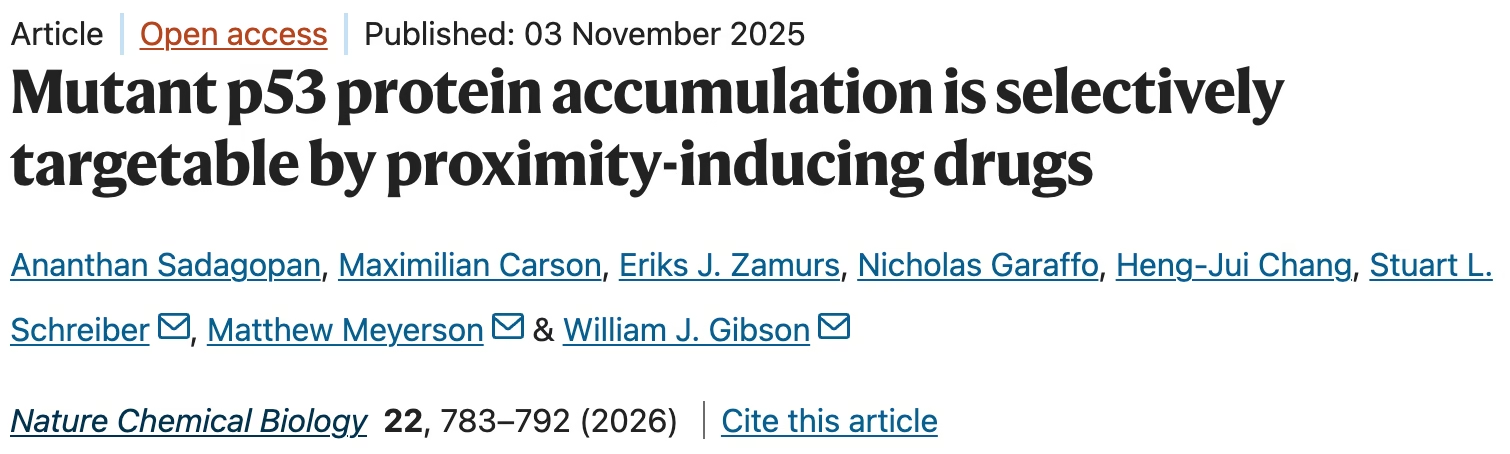
Mutant p53 protein accumulation is selectively targetable by proximity-inducing drugs
Key figures
- [Supplementary Figure 1]: Establishes the clinical motivation by estimating that TP53-mutant cancers account for approximately 45.6% of cancer-specific deaths in the analyzed cBioPortal survival subset.
- [Figure 1]: Shows that TP53-mutant cancer cells lack enriched CRISPR dependencies or cell-surface protein markers, while p53 itself is the dominant proteomic feature increased in TP53 missense-mutant cells.
- [Figure 2]: Demonstrates the core abundance-targeting principle using Halo-tagged p53 fusions, where a Halo–PLK1 bifunctional selectively inhibits cells with high p53-fusion abundance.
- [Figure 3]: Shows that PMV6-PEG4-BI2536/p53-01 induces p53-Y220C–PLK1 proximity, PLK1 mislocalization, selective apoptosis, G2/M arrest, and PLK1-pathway inhibition in p53-Y220C-expressing cells.
- [Figure 4]: Demonstrates that p53-01 acts in endogenous TP53Y220C settings without p53 transcriptional reactivation and that its activity depends on p53-Y220C engagement.
- [Table 1]: Quantifies linker-dependent proximity SAR, identifying PMV6-C3-BI2536 as the most potent bifunctional with 25 nM competition EC50 and 0.41 µM NanoBiT EC50.
- [Figure 5]: Correlates growth-competition potency with NanoBiT ternary-complex formation across linker variants, supporting ternary-complex formation as the functional driver.
1) Thesis (one sentence)
To address the lack of generalizable strategies for selectively killing TP53 missense-mutant cancers despite absent synthetic-lethal dependencies, in p53-overexpressing surrogate systems and endogenous TP53Y220C cancer cells, p53-Y220C–PLK1 bifunctional proximity drugs cause selective cell killing, G2/M arrest, and apoptosis by using abundant mutant p53 to concentrate and mislocalize PLK1 inhibitors through p53Y220C–PLK1 ternary-complex formation, supported by DepMap/CCLE proteomics, NanoBiT, live-cell imaging, competition viability assays, RNA-seq, reporter assays, flow cytometry, Western blotting, and linker SAR.
2) Evidence card (three bullets only)
- Strongest result: (Fig. 3; Fig. 4; Fig. 5; Table 1) p53-01 selectively depleted p53-Y220C-expressing cells, induced apoptosis and PLK1-inhibition phenotypes, retained activity in endogenous TP53Y220C contexts without p53 reactivation, and linker optimization improved the growth-competition EC50 to 25 nM for PMV6-C3-BI2536.
- Method enabler: (Fig. 2; Fig. 3; Table 1; chemical biology + induced-proximity pharmacology using bifunctional synthesis, Halo surrogates, PMV6 p53-Y220C binding, BI2536 PLK1 inhibition, NanoBiT, live-cell colocalization, FACS competition, CTG, RNA-seq, and Western blotting) A p53 binder was linked to a low-abundance essential kinase inhibitor so that elevated mutant p53 abundance could be converted into a localized PLK1-inhibition signal.
- Critical limitation: (Fig. 3d; Fig. 4i; Table 1) The validated endogenous strategy is Y220C-specific because PMV6 binds a Y220C-created pocket, p53-01 does not kill R273H cells, and chronic exposure selected p53-Y220C reporter-negative cells, indicating a concrete antigen-loss resistance mode.
Optional
Quote bank (2–4 short excerpts)
- Quote 1: “Here, we demonstrate an induced proximity approach to selectively kill TP53 mutant cells.” (Abstract, page 783)
- Quote 2: “TP53-mutant cells strongly upregulate p53 protein” (Results heading, page 784)
- Quote 3: “p53-targeted drugs need not restore native p53 function” (Discussion, page 790)
- Quote 4: “Future generations of molecules may have no toxicity in the absence of p53 proteins” (Discussion, page 790)
Key comparisons (1–3 lines)
- Compared to: p53 refolders, TP53 synthetic-lethal searches, immunotherapy, and direct PLK1 cytotoxins.
- Win: Converts mutant p53 accumulation into a druggable proximity handle and kills TP53Y220C cells without requiring restoration of p53 transcriptional activity.
- Tradeoff: Depends on a Y220C ligand and still carries dose-limiting risk from the nonspecific PLK1-inhibitor payload outside the p53-bound context.
Methods I might copy (protocol hooks)
- Construct design / Models: Use 293T or Calu-1 cells stably expressing Halo–p53-R273H (FL)–mCherry or Halo–p53-Y220C ΔTAD–mCherry for abundance-gated competition assays; use Calu-1 Halo–p53 WT/R273H–mCherry–2A–mTagBFP2 to separate transcript expression from protein stabilization; use NanoBiT with mEGFP–PLK1–SmBiT and NLS–LgBiT–p53-Y220C (DBD); use Huh7 TP53Y220C/Y220C and MFE319 TP53Y220C/R273C for endogenous testing; use MFE319 sgTP53–Cas9–EGFP competition to test p53-dependence.
- Conditions / Instruments: Test p53-01 in 293T p53-Y220C competition from 250 nM to 2 µM over 8 days; compete p53-01 at 250 nM with PMV6 at 2.5 µM; perform NanoBiT after 24 h compound treatment; treat Huh7 cells with 4 µM PMV6 or p53-01 for 24 h before RNA-seq; run p53 luciferase reporter assays after 16 h treatment; treat synchronized cells for DNA-content analysis for 1 day; run Western blot after 8.5 h using p53-01 1.5 µM, PMV6 1.5 µM, and BI2536 20 nM; evaluate linker variants spanning 4.33–22.22 Å with growth-competition and NanoBiT EC50 readouts.
- Readout / Analysis: Use CTG and crystal violet for proliferation, FACS for mCherry/mTagBFP2/EGFP competition, RT–qPCR normalized to GAPDH for transgene expression, NanoBiT luminescence for ternary-complex formation, live-cell EGFP/mCherry imaging for PLK1 relocalization, caspase 3/7 and annexin/PI for apoptosis, DAPI DNA content for G2/M arrest and genome doubling, cyclin B1 plus phospho-PLK-binding motif Western blotting for PLK1 inhibition, DESeq2 and GSEA for RNA-seq, and linker SAR to correlate ternary-complex formation with selective killing.
Open questions / Theoretical implications (2–5 bullets)
- Can p53 abundance-dependent killing be converted from a bivalent inhibitor strategy into a true molecular-glue strategy with no basal PLK1-inhibitor toxicity?
- Can pan-p53 or mutant-class-specific ligands extend the approach beyond Y220C while preserving selectivity over stressed normal cells with transient WT p53 accumulation?
- Is antigen loss through reduced mutant p53 expression the dominant resistance route, or will PLK1-pathway rewiring, drug efflux, and altered cell-cycle state also emerge?
- Can ternary-complex geometry predict selective cytotoxicity better than binary affinity of the p53 binder or PLK1 inhibitor alone?
![Read more about the article [Paper Review #23] De novo mapping of α-helix recognition sites on protein surfaces using unbiased libraries](https://pharmphd.com/wp-content/uploads/2026/05/image-5-300x88.avif)
![Read more about the article [Paper Review #18] Structural determination of small proteins by cryo-EM using a coiled coil module strategy](https://pharmphd.com/wp-content/uploads/2026/05/image-300x80.avif)
![Read more about the article [Paper Review #26] Computational design of conformation-biasing mutations to alter protein functions](https://pharmphd.com/wp-content/uploads/2026/07/image-4-300x89.avif)